What it is
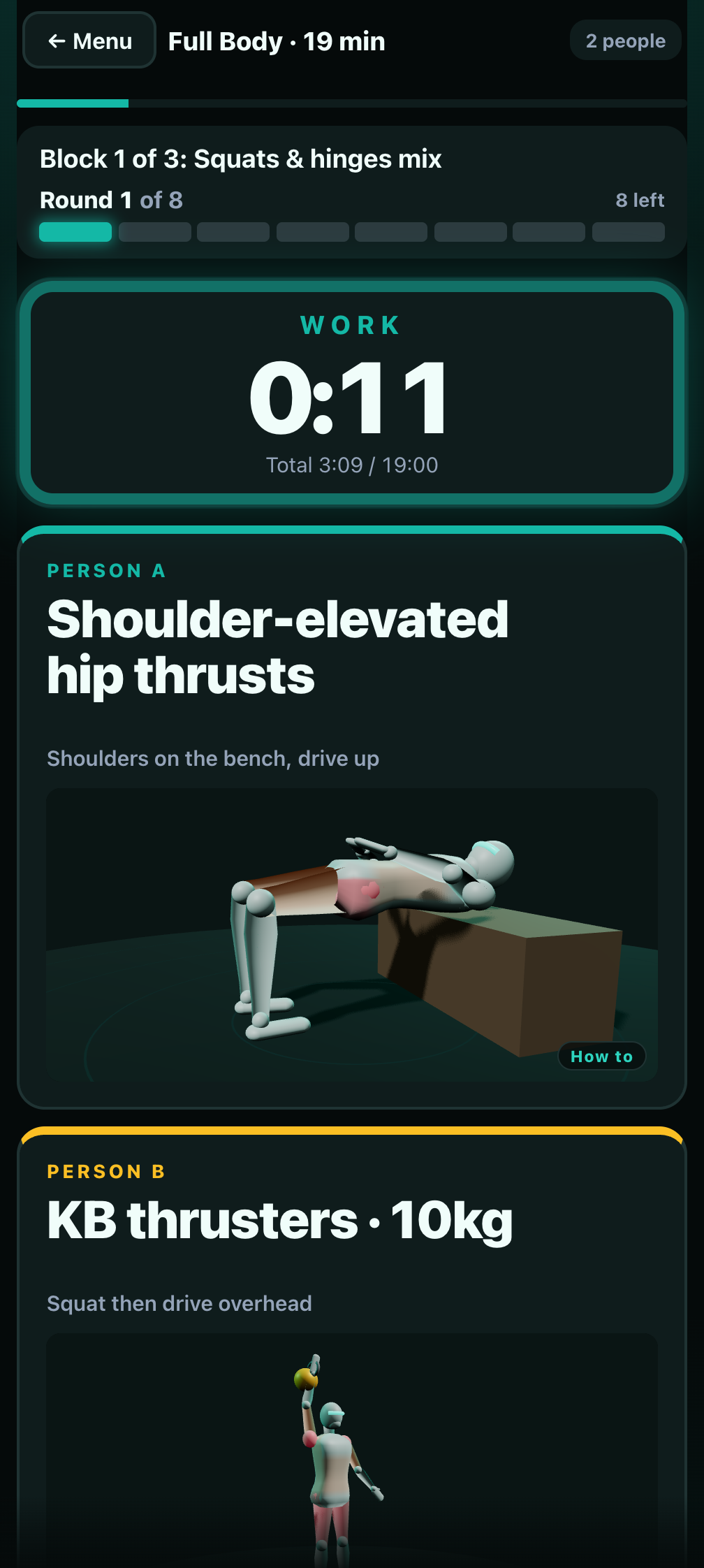
FIT is a workout timer for a home gym. It runs in a browser or as a home-screen app on a phone or iPad, builds a workout around the gear you actually own, and walks you through it with a big clock, audio cues and a 3D figure showing each movement. The thing that started it is still what makes it different: it knows you only have one of each weight.
How it started
My wife and I were getting ready to do a workout in the garage. She wanted something strength-focused, Tabata-style, with the kit we actually had. I went to find an interval timer app and got annoyed within thirty seconds at the same problem I'd hit before: every timer assumes you can just hand the same kettlebell to two people at once. We have one 15kg kettlebell, one 10kg, one barbell, one set of rings, a skipping rope, and a long gravel driveway. Two people can't both do swings on the heavy KB at the same time.
So I went into Claude Code, described what I wanted, told it the equipment list, and asked it to build me a workout timer that understood the constraint. With the GitHub and Vercel connections plumbed in, the build went straight from prompt to a live URL we could open on the iPad. About fifteen minutes from the first message to walking back out to the garage with our phones in our pockets and the timer running on the wall.
We did the workout blind. First run, no review. It worked really well.
What it does now
It began as a timer with eleven fixed workouts. Now it builds a fresh one every time.
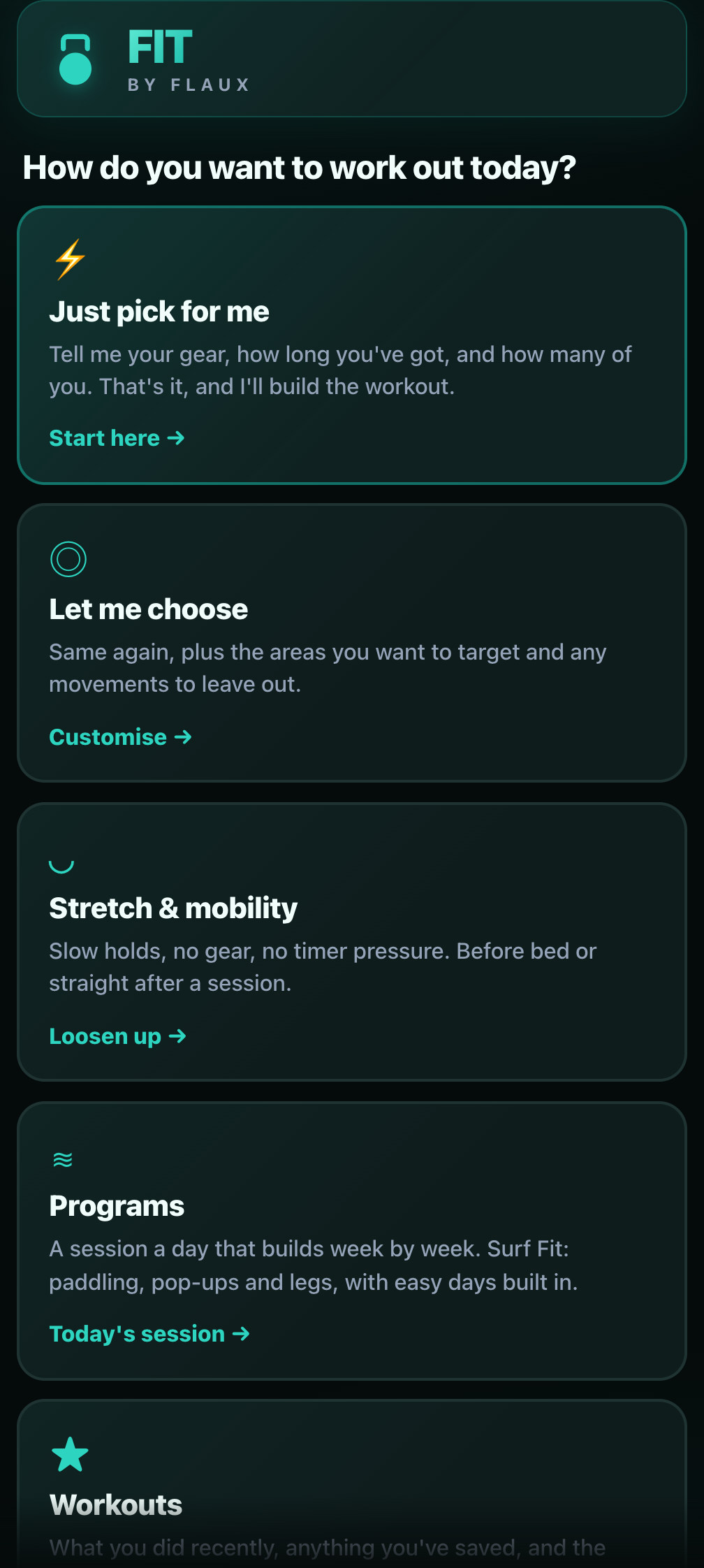
The home screen asks how you want to train. Just pick for me asks for your gear, how long you've got and how many of you there are, then builds the session. Let me choose adds which parts of the body to target and anything you'd rather skip. There are stretch and mobility routines too, and a list of what you did recently and what you saved.
Workouts come from a library of more than 150 movements, and the generator remembers what you did last time, so back-to-back 30-minute sessions share under a quarter of their movements.
Every style runs in four-minute blocks, so switching styles never changes how long a workout takes:
- Short bursts and long efforts, the classic interval timers
- EMOM, with a rep target for each exercise and the rest of the minute to recover
- AMRAP, one lap repeated as many times as you can, with last time's score to beat
- For Time, a set number of laps against the clock
- Mix, two or three of those in one session, fitted to the time you've got
It picked up a lot more along the way:
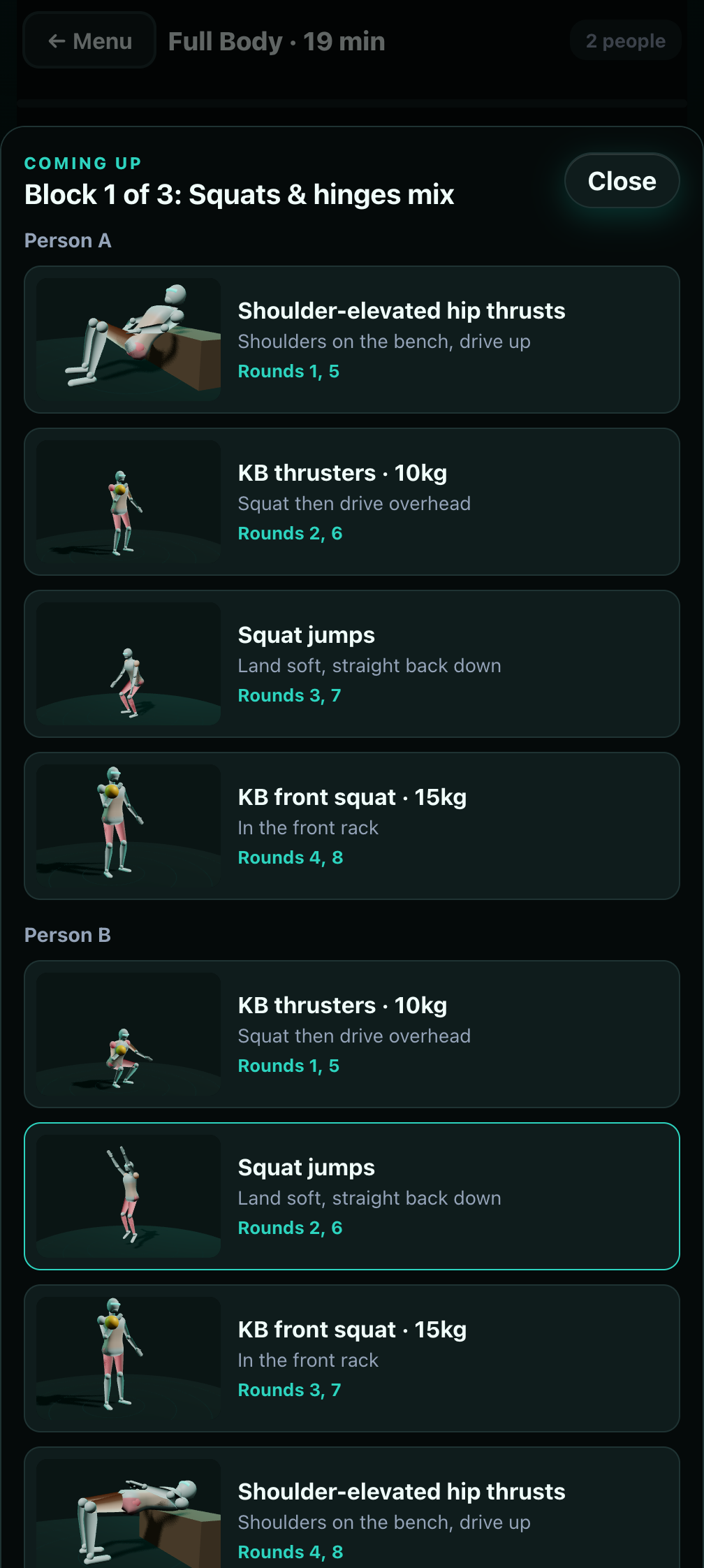
- A 3D figure for every exercise, and a preview of the next block while you rest
- Your own weights: kettlebells, dumbbell pairs and the load on the bar
- More gear (pull-up bar, resistance bands, medicine ball, box or bench) and saved gear sets for each place you train
- A surf fitness goal, and Surf Fit, a six-week program of daily sessions
- Share a workout as a link, and it works offline
The one-of-each rule still runs through all of it. In an AMRAP for two, the second person starts one exercise along, so you're never in step. Anything in their lap that also needs the kettlebell, barbell, rope or rings from the first person's lap switches to a bodyweight version.
How it's built
Still static files with no build step, hosted on Vercel at fit.flaux.com.au. The 3D figures run on three.js, a service worker keeps it working offline, and a Playwright test suite runs in GitHub Actions on every change. A generator that composes workouts on the fly needs checking in ways a list of eleven fixed workouts never did. Source at github.com/TNCC01/flaux-fit.
The bigger lesson
The story I keep coming back to with this one is the fifteen minutes. The reason it landed that fast wasn't that AI is magic. It's that I'd already done the boring groundwork: a connected GitHub account, a Vercel project pattern that auto-deploys on push, a brand palette and logo system that snapped in without thinking, and a habit of describing constraints rather than handing over a vague brief.
The AI did the typing. The setup is what made it possible to type, run, and use in the same session.
The second lesson came later. Fifteen minutes got a timer on the wall. Turning it into something that builds a different session every day took a rebuild around a generator, a proper test suite, and about fifteen more releases.
Status
Live and in use. The latest additions, in October 2026, were the EMOM, AMRAP and For Time styles, mixed sessions, your own weights, more gear, and the Surf Fit program.